Talking about Malawi Politics and other stuff. Occasionally, we journey across the borders and look at what our friends are doing and what we can learn from them...
Friday, April 6, 2012
Reflections on President Bingu wa Mutharika’s passing
Thursday, April 5, 2012
A fresh start for Malawi after Mutharika?
Wednesday, March 14, 2012
My ‘Terminal’ experience at Nnandi Azikiwe Airport in Abuja, Nigeria
One of my favorite movies is "The Terminal". The central character in the movie, played by Tom Hanks, is stranded at a New York's JFK Airport after a revolution in his country leaves him stateless, as a result of which he is refused entry into the United States by immigration authorities. However, unable to return to his home country, Hanks' character spends a couple of months living inside the airport terminal, finding lots of unique ways to survive, making friends and falling in love. Eventually, the situation in Hanks' country gets resolved and he is now allowed to enter the US before eventually returning to his homeland.
I have been thinking a lot about The Terminal movie of late after personally going through a similar experience at Nnandi Azikiwe Airport in Nigeria's capital of Abuja. Transiting from Cotonou, Benin, en-route to Accra, Ghana, I was refused boarding on a Delta Airways flight at Nnandi Azikiwe Airport because the officials insisted that I present to them a copy of my Ghanaian Visa, which had been processed for me by my Ghana colleagues to pick up on arrival at the Airport in Accra. Unable to proceed, I was caught in a state of "statelessness" – unable to board my flight or get out of the airport as I did not have a Nigeria visa either.
Thanks to the outstanding service of Cathy Witchel of Passageways Travel, I was rebooked on a different flight from Abuja back to Michigan through Amsterdam (Cathy has really been exceptional in planning my travel bookings, which often require stops in multiple countries, and complicated by requests for last minute changes). The only catch was that the new flight was leaving Abuja almost 30 hours later. This meant having to spend all of Thursday night and almost all of Friday within the immigration hall at Abuja Airport. Tough, but the Nigeria immigration staff were kind. They allowed me to make phone calls to reach my Travel Agents back in the USA and also to reach my colleagues in Ghana and the US to alert them of my predicament.
In hindsight, I should have made sure I had the Ghana visa sorted out before changing my original itinerary. But as the French say, c'est la vie. We live and learn. It is a lesson to others though that always have the right documentation or else you are forced to tough it out and have your own 'airport terminal' experience!
********
While the Immigration officials at Abuja Airport were in no way to blame for my predicament, I must say my recent travels across Africa have demonstrated to me how very archaic some of our immigration rules are. Apart from the high travel costs around the continent, most of our countries have some of the most restrictive visa rules, especially for fellow African travelers. I recently had to cancel plans to travel to Cameroon over very cumbersome and lengthy rules for getting a visa to travel to the country. A colleague of mine from Uganda also encountered similar challenges in acquiring a visa o travel on business to Nigeria. These episodes also reminded me of a journey to Namibia some four years ago, when the immigration officials at Hose Kutako Airport in Windhoek refused to issue me a three week visa insisting instead that I provide a work permit to conduct research in the country.
In all these cases, immigration/ visa officials were simply enforcing existing rules and in no way were they to blame. The common theme though is that most of our countries have unusually very difficult and unreasonable visa rules that are ultimately detrimental to the countries themselves. In today's globalizing world, we should be seeking ways of making entry to our countries as easy as possible – granted without sacrificing issues of national security. As things stand, one gets the impression that visa rules are based on the wrong perception that there are many people desperate to enter our countries and take away our resources.
It is sad that it is perhaps relatively easy for me to travel to Europe and the Americas than to many of our African countries. That said, it is not all countries that have these crazy and cumbersome immigration rules. Coincidentally, those countries with relatively open immigration rules are among those that are the most attractive international destinations. Ever wondered why countries such as Kenya, Tanzania, Mauritius, Ghana to give but a few examples, are very popular international destinations?
Monday, February 13, 2012
An interesting piece on bicycle ambulances in the Malawi Daily Times
"I think the preferences of the people were not looked into when introducing the bicycle ambulances. Sick people hate them because they equate them to hospital stretchers which are used at hospitals to carry dead bodies....Maleya said despite the ambulances being distributed, he has a strong feeling that most of them are not used."The article ends with the interesting observation by Maleya, who is the District Aids Coordinator for Mchinji district in central Malawi that despite the strong resistance by the public to use bicycle ambulances, they "are important and what was required was sensitisation to change the people's attitudes." This is a classic case of partners and officials who think they know better than the people they are trying to serve. Considering that the people featured in the Daily Times piece are said to prefer to use ox-carts to ferry sick people to hospitals, it is interesting that the advocates of bicycle ambulances do not even attempt to make any argument about why bicycle ambulances are better than the oxcarts and simply claim they are important. While I would not advocate for using ox-carts as a new form of ambulances either, the proponents of bicycle-ambulances could do better in my view to support and help to improve the ox-cart ambulance technology instead of thinking they know better and will continue to push bicycles on a people that are resisting them.
Thursday, February 2, 2012
My One week in Malawi part II: a wasted 20 hours on petrol queues
| That's not a traffic jam: it is a fuel queue! |
In the end, I had to make do with petrol bought on the Mozambican road-side in Dedza, sold at MK600/litre ($3.7 at the official exchange rate or $2.3 on the thriving parallel exchange market). After failing to buy extra petrol at any of the three filling stations that received deliveries while I was in Zomba, I was forced to purchase from the parallel market yet again at the cost of MK1,000 per litre ($6.21 at the official exchange rate or $3.84 on the parallel market) - this translated to a whopping 163% above the official pump price of MK380/litre.
I found it interesting that at almost the same time Nigerians were on the streets protesting the removal of petrol subsidies in their country, Malawians appeared resigned to their fate. Many motorists would 'abandon' their vehicles at fuel stations hoping to be at the head of the queue in the event of a fuel delivery. Rumours of pending fuel delivery would always be met with hectic activity, cars being driven or pushed to join fuel queues that at times extended for more than 3 kilometers. And whenever a delivery was made, it was interesting to note that many people make it a point to know exactly how much fuel has been delivered at any particular fuel station.
The greatest disappointment for me is how little blame the Mutharika government is getting for the fuel shortages (in addition to the other myriad shortages such as forex, hospital drugs, and some basic commodities from shops). With the small Malawi middle class resorting to buying fuel on the parallel market and the majority of the blame being heaped on fuel attendants and those who buy fuel in containers locally known as "zigubu," the majority of Malawians, it would appear, have taken heed of former Energy Minister, Grain Malunga's advice and gotten "used to the fuel shortages." I thus never got the sense that the Malawi government's abysmal handling of the fuel fuel shortages would result in anything resembling the Nigerian fuel-subsidy of demonstrations. This, in my view, is Malawi's biggest tragedy: the inability of people to put pressure on government officials whose job it is to ensure that these type of shortages should not occur.
In this political environment, there is almost zero chance of the type of demonstrations that recently led to the toppling of dictatorial regimes in the Arab world.
Sunday, January 29, 2012
My one Week in Malawi - Part 1: Reflections on the forex crisis
The beauty of the country at this time of the year notwithstanding, one cannot escape the severe economic crisis afflicting the country.
| What is the Dollar worth in Malawi Kwacha: MK165 or MK270? |
The Malawi government faces a big decision on revamping its antiquated forex exchange policy. Clearly, the fixed exchange rate policy is not working as it is failing to keep pace with unfolding developments. At the official rate of $1=MK165, the Malawi Kwacha is grossly overvalued. This is causing a lot of hurt to the formal banking sector, and, by extension, businesses and individuals that cannot transact on the parallel market. The crippling fuel shortages are meanwhile one of the most visible manifestations of the consequences of this failed forex policy (the fuel shortages are a blog piece for another day!)
While a major devaluation of the Kwacha, as demanded by the IMF and most local economists might help to ease the forex shortages, I must say I am no longer convinced this will be a sufficient response. While the IMF is reported to have been recommending an exchange rate of between MK230-250 to the Dollar, these would still be below the rates currently being offered on the parallel market. It is thus doubtful any devaluation to the levels being recommended by the IMF would encourage more people to transact on the formal foreign currency market. Indeed, as my friend Joseph Chunga at Chancellor College told me during the week, chances are high that even if the devaluation matched the current rates on the parallel market, the informal forex dealers would most likely respond by adjusting their rates upwards, thus neutralizing any potential benefits from the devaluation.
In my considered opinion, the only solution lies in a major policy shift towards a full liberalization of the Kwacha. This would free the banks to match the parallel market and thus make them competitive again in the forex market.
Many, including President Bingu wa Mutharika will argue that a wholesale liberalization of the currency market will lead to skyrocketing of prices for commodities. And they will be right. However, what should also not be overlooked is that under the current set-up, prices are already going up while many commodities are becoming scarce and unavailable. In my one week stay, I experienced first hand shortages of sugar, soft drinks, some brands of soap, and of course, fuel. The forex squeeze, in other words, is creating a disequilibrium in the market, whereby demand for goods is exceeding supply, resulting in shortages and price increases. Again, the fuel market offers a clear example of this imbalance. While the official price of petrol is K390 per litre, the price the parallel market price was fluctuating between K600 and K1,500 per litre during the week.
Of course liberalizing the Kwacha is no sure guarantee that forex will become available overnight. Indeed, a currency devaluation or liberalization without any immediate infusion of foreign currency will most likely make the situation even worse than it already is. But not devaluing is no option either and it has become inevitable. At least, devaluation will encourage many Malawians in the diaspora to start transacting in the formal sector again, generating forex for local Malawian business. The dormant Malawi businesses might also rise again from their forex-shortage induced comas and begin to generate some forex through exports. Above all, a devaluation of the Kwacha will most likely lead to the restoration of the suspended programme with the IMF, thus clearing the way for foreign donors to restore the suspended budgetary support to Malawi.
Will this happen? I have my doubts. Mutharika has been adamant in his resistance to devaluation. I do not see him becoming open to a full-fledged liberalization of the currency market. My best guess will be that the Malawi government will eventually be forced to opt for another small devaluation in the short to medium term. However, such piecemeal devaluation will not offer a solution to the current economic crisis. Malawi's dire economic situation requires serious shock therapy, and only a serious devaluation that at least matches the parallel market exchange rates will do. The alternative is catastrophic to imagine.
Monday, January 9, 2012
Saying no to mediocrity: refusing to accept ‘bicycle ambulances’
A story in the local Malawi media a few weeks back about the donation of 'bicycle ambulances' in Salima district got me thinking about how as a country we have come to accept and embrace mediocrity.
I must confess to being troubled by the increasing frequency of the donation of bicycles to be used as ambulances. In the 21st century, it is both sad and shocking that any people should be using bicycles as ambulances. By definition, ambulances are supposed to provide primary care and quick transport to hospitals to those in need of urgent medical care. They are supposed to have life-saving equipment on board, managed by trained para-medics that provide a first line of medical assistance before one can be transported to be seen by a medical professional.
The idea of a 'bicycle ambulance', on the other hand, reduces the function of an ambulance service to mere transport for patients, albeit one without the requisite speed or comfort. Granted, ambulances in Malawi are very rarely used to provide urgent access to hospitals, with the possible exception of road accident victims.
Indeed, the definition of an ambulance in Malawi appears to be reduced to simply a vehicle that has a thick red cross painted on the sides. There are no phone numbers that people in need of urgent medical care can call to request an ambulance. Like their bicycle cousins, ambulances are simply a means of transport to or from a hospital. Most lack basic life-saving equipment on board. And off course there are no paramedics on board Malawi's ambulances.
More often than not, people only see ambulances in villages when they come to deliver dead bodies – a role that is meant for hearses, not ambulances. Many a time, ambulances are used to carry fee-paying passengers, even when they have patients or dead bodies on board, with the money going into the pockets of the drivers.
For a people that have no reliable access to ambulances or other means of transport to take patients to hospital, perhaps there is something to celebrate in receiving a bicycle ambulance. Indeed, in this day and age when fuel has become such a scarce commodity, perhaps bicycle ambulances are the way to go.
However, I still fail to see anything worth celebrating about the increasing trends of 'bicycle ambulance' donations. Several of Malawi's NGOs seem to have carved a niche in soliciting and handing out these foot-propelled 'ambulances'. If anyone outside Malawi wants to help the country, they should be told in no uncertain terms that Malawians need and deserve real ambulances. Bicycle ambulances do not belong to the 21st century, in Malawi or anywhere for that matter. It is as simple as that. Even an ox-drawn cart can make a better hospital ride than a bicycle in my view.
That we celebrate these donations and make them to be such big events as happened in the Salima episode reflects sadly on our own acceptance of mediocrity. Perhaps this should come as no surprise. It all starts with our acceptance of mediocre leadership, which trickles down to many other areas, including poor quality buildings, poor roads, poor services to mention but a few.
Monday, December 12, 2011
Wednesday, November 23, 2011
Zonse zimatha nkukambirana? even on fuel? Let us get serious!!!
Yes, while I have had a number of good chuckles at the depictions of the long fuel queues by Malawi's ever creative cartoonists, these laughs have been overshadowed by the recent ministerial statement by Natural Resources, Energy and Environment Minister, Goodal Gondwe, on how government proposes to address the crisis. According to the Nation of Friday, November 18th, Gondwe told Parliament that one of the options being pursued by the Malawi government is "discussing with suppliers the possibility of buying the fuel using the local currency, the Kwacha, instead of the US Dollar as is the case now."
For a man that has had an illustrious career in many an international financial institutions, Gondwe's suggestion is so laughable as it amounts to no solution at all. If paying for fuel imports using the Kwacha was ever an option, Malawi would not have had this crippling fuel shortage in the first place.
If I may ask, why would the suppliers accept to be paid in Malawi Kwacha? What would they do with those Kwachas? Already, Malawians are struggling to find basic commodities to buy even when they have pocket-fulls of Kwacha currency.
And talking to Zimbabwean colleagues, this is exactly what happened at the start of their own economic collapse a few years back - people having bucket-loads of a local currency that could not buy them anything. So what fuel supplier in their right mind will accept to be paid in a currency that cannot buy anything? If this is the best solution we can come up with, then we should simply brace of even more difficult times ahead. The government meanwhile should simply admit they have failed to find a solution to this crisis, caused in large part of course because of their own inept policies and gross incompetence.
Mr. Gondwe's proposal for discussion seems to be reflective of a wider approach to decision making in this government - thinking we can solve our problems, most of our own making, by using the old-age Malawi adage that "zonse zimatha nkukambiriana" - everything can be resolved through discussions.
While a lot can be gained through discussions, we have to realize that mere talking without addressing the underlying concerns that led to some of the problematic relationships will not do. Going to the World Bank and the IMF with the sob-story that Malawi is hurting without addressing the concerns that led to the suspension of the Extended Credit Facility, ECF, in the first place is just wishful thinking. Merely meeting donors and asking them to resume aid when we have taken zero steps in addressing the concerns that led to the suspension of aid in the first place reflects a mypoia of the highest order.
Let us act and address the challenges and concerns that got us into the current situation. We can then have something to discuss. Until then, Mr Gondwe and your likes, you are increasingly being revealed to be the jokers that you are.
Saturday, October 15, 2011
2011 COMESA Summit: a gathering of tyrants
Burundi: 5 (Partly free)
Eritrea: 7 (Not free)
Sudan: 7 (Not free)
Swaziland: 6 (Not free)
Zimbabwe: 6 (Not free)
In other words, the Heads of states that bothered to come to to Malawi for the just ended COMESA summit trend towards dictators presiding over countries that have extremely low political rights and civil liberties scores. As a matter of fact, two of the Presidents attending the Lilongwe meeting (Al Bashir and Isaias Afawerki) come from countries that have the lowest possible score on the Freedom House ranking of 7. Both are cited in the 2011 report as being among the world's most unfree countries, with Eritrea described as an "increasingly repressive police state."
The only country with a presidential delegation at the Lilongwe summit that can claim to come from a somewhat tolerant society is Burundi, whose uninspiring score of 5 falls among the category of countries rated as "Partly Free".
And if anyone is interested to see where these countries rank on the Mo Ibrahim Governance Index, I suggest you start looking from the bottom of the list and go upwards - you will save a lot of time that way. Swaziland is the highest ranked country on the Index, at number 26 among 53 African countries. The rest are: Burundi (37), Eritrea (47), Sudan (48) and Zimbabwe (51).
Given how hard President Bingu wa Mutharika has worked hard to join the exclusive club of African dictators, I am tempted to opine that the 2011 Lilongwe COMESA summit serves as an endorsement of Mutharika's acceptance into this exclusive club of African dictators. While the presidents that represent COMESA's more progressive democracies have shied away from getting their democratic credentials tainted by associating with Mutharika, the dictators of the COMESA grouping have felt a natural attraction and have joined their Malawi colleague to cement his entry into the club..
Friday, October 7, 2011
Cry, my beloved Malawi
I was impressed with how resolute Lecturers at Chancellor College remain in the struggle for Academic Freedom. On a couple of occasions, I walked in solidarity with my colleagues as they took part in their daily freedom walk around the Chirunga campus and sang the abridged version of the national anthem.
I also had the opportunity to watch the Malawi Flames take on Tunisia in an Africa Cup of Nations soccer qualifier game at the Kamuzu Stadium. It is perhaps a reflection of how far Malawi soccer has advanced (well, the national team version that is) that most people came home disappointed with a 0-0 result against one of the giants of African soccer.
Sadly, there were so many challenging encounters that made me somewhat happy to leave it all behind. Driving to Neno on one of the worst roads imaginable or to Nakhunda in Zomba on a road that has no right to be in a city (if one believes the bill board on the road side from Zomba to Nankhunda) made me wonder what stuff the President and his cronies are smoking when they say Malawi has made so much development progress.
The constant struggle for fuel - where the only reliable source of diesel is Tsangano turn off- or the frustrating lack of forex in the country, just demonstrated how challenging life has become in my beloved Malawi. This is not even to mention the high and ever increasing price of commodities.
Now to hear of extra judicial killings of innocent demonstrators and student activists while the defenders of the regime froth on their mouths with a lot of stupid diatribes; a clue-less civil society that appears to care more about preserving their jobs than standing up for the ordinary citizen, I dread to think where my beloved Malawi will be in a year's time.
A failed leadership, an apathetic public, an incompetent civil society can only translate into a failed state. That is what Malawi has become.
Tuesday, August 9, 2011
Questioning Vuwa Kaunda's understanding of patriotism
But what I found laughable is Vuwa's argument that the Malawians who signed a petition urging the Hunger project to withdraw the award are unpatriotic.
From its Greek and Latin origins, the word patriotism represents a devotion to one's country. Loyalty and devotion to an individual do not count. Yet, the Vuwa Kaundas of this world have time and again demonstrated that their loyalty and devotion is to the person of Mutharika, a man who is single-handedly causing untold and unprecedented ruin on Malawi. This is not patriotism Mr. Kaunda. The true patriots are those Malawians that have shed their blood for the country, not those who have shed that blood on behalf of Mutharika. The true patriots are those Malawians who urged the Hunger Project to rescind their offer in fear that it will give the President more ammunition to govern the country as a personal estate and bring further ruin.
Thanks, but no thanks to another Muluzi or Mutharika
"I am reluctant to lend my support to Hilary Clinton on one count and one count alone: in a country of nearly 300 million people, I cannot be convinced that there are only two households that can produce Presidents...."To hear that the DPP, as predicted, has endorsed Peter Mutharika as the party's candidate to succeed his brother, Bingu wa Mutharika, while Atupele Muluzi, son to former President Bakili Muluzi, is seriously contemplating to contest for the state presidency, brings back to mind the same notion that made me reject Hilary Clinton's candidature. While I have nothing personal against Atupele Muluzi or Peter Mutharika, I refuse to accept the underlying perception that out of the 13 million plus Malawians, only the Muluzis and Mutharikas are capable of producing presidential caliber individuals.
If truth be told, the Muluzi era, which was characterized by mismanagement, corruption and incompetency, will count among Malawi's lost years. As for the Bingu years, need I say more? As they say, the works of his hands speak for themselves - murder of innocent Malawians, long fuel queues, deprivation of academic freedom, forex shortages, arrogance and corruption of the grandest scale - are showing that he is not only out of touch with reality, but also that his style of leadership does not belong to a Malawi of the 21st century. And for some to claim they want Peter Mutharika to continue his brother's legacy is, in my considered opinion, pure lunacy.
The long and short of this post is that if Atupele and Peter- who admittedly have to be judged in their own merit, not by the performance of their fathers or brothers - stand for presidential office in 2014, I would, on principle, not vote for them. Malawi belongs to us all, not just for families of Kamuzu Banda, Bakili Muluzi or Bingu wa Mutharika. I would rather we looked elsewhere among the millions of my country-folk for a new leadership. This is no guarantee that we would get a better leader, but we would be giving others the opportunity to captain the ship. So, nothing personal about Atupele Muluzi or Peter Mutharika, but thanks, but no thanks.
Wednesday, July 20, 2011
Bingu and his government have lost legitimacy
It is obvious Bingu and his cast of sycophants are living in an alternative dream world, a lala-land so far removed from reality. To hear these syncomphats from the public media and the DPP (I now refuse to call the DPP the ruling party because it seems to have stopped governing - it has just been reduced to praise singing for Bingu) makes my blood boil. Simply put, Mutharika and his cronies can no longer claim to genuinely represent the people of Malawi.
Now, the cowardly attempts by the government and its agents to prevent Malawians from exercising their right to demonstrate (as provided for under Section 38 of the Malawi Constitution) has further demonstrated the widening gulf between those who are governing and the governed. Indeed, the spontaneous outbreak of violence across the country make Blessings Chinsinga's ill-fated lecture about how policy failures by government can cause extreme public disaffection sound prophetic. When governments fail to fulfill their side of the democratic bargain, the link between the governing and governed is irreparably broken. The only option for the people then is to take matters into their own hands.
A goverment that relies on force to frustrate the people's aspirations, to take away their constitutionally guranteed rights through dubious decisions handed in the middle of the night, has lost legitimacy and can no longer claim the right to govern. The authority to govern, as provided for under Section 6 of the Malawi Constitution derives from the people and is to be used solely to protect and promote their interests, not the interests of one man or a particular ruling clique. And because democracy is government pro-tempore, once the link between the rulers and the ruled has been broken, as it has in our present case, the country needs to move in a different direction. Malawi, as I wrote in my previous post, is bigger than Bingu and his cronies. It is indeed bigger than any of us. We will all die and be gone but Malawi will still be there. To provide that opportunity for Malawi to move on without being ruined, Bingu and his cronies need to go. now.
Friday, July 15, 2011
In Support of the demonstrations against bad governance in Malawi
However, I would like to register my support for my countrymen planning to go out on the streets to demonstrate against the poor governance record of Bingu wa Mutharika, whose arrogance, myopia and incompetence are bringing untold miseries on the innocent Malawi folk.
Mutharika is but one man. The thirteen million other Malawians deserve a better leadership that can work in their interests. Down with this dictatorship.
Wednesday, June 15, 2011
Ranking the Performance of African Presidents - The Evidence from recent Afrobarometer Surveys
That said, the East African Magazine article had a number of flaws. The one that jumped out the most was the mixing of both ceremonial and full executive presidents in the rankings, despite the fact that the former wield very little power. In some cases, such as Morocco and Swaziland, the rankings rated the performance of monarchs. Surprisingly, in the Kingdom of Lesotho, the ranking was for Prime Minister Bethuel Mosisili instead of King Letsie III. In a nutshell, the East African rankings were a mixed bag of apples, oranges and even peaches that were being passed off as one and the same thing.
An alternative way to rate the performance of African leaders is to ask the ordinary people themselves on how they assess the performance of their leaders. Granted such ratings would differ depending on country-specific circumstances, but to the extent that such assessments are what influence decisions during elections, they can serve as more objective pointers than the subjective ratings of 'experts' that are far removed from the reality on the ground.
Fortunately, the availability of Afrobarometer Survey data makes it possible for us to start to track and compare popular assessments of the performance of African presidents. So I went back and looked at the data from the most recent Afrobarometer Surveys (conducted in 20 countries between 2008 and 2009) to compare responses to the following question:
"Do you approve or disapprove of the way the following people have performed their jobs over the past twelve months, or haven't you heard enough about them to say: President (name)"?
The 2008 surveys covered a total of 20 countries, 19 of whom have executive presidents. In the following table, I combine the responses for strongly approve and approve to gauge the proportion of respondents that expressed approval for the performance of the leaders in the 19 presidential-regime countries.
| Ranking | Name of President | Country | Approval Rating (%) |
| 1 | Jakaya Kikwete | Tanzania | 89 |
| 2= | Ian Khama | Botswana | 88 |
| 2= | Hifikepunye Pohamba | Namibia | 88 |
| 4 | Bingu wa Mutharika | Malawi | 83 |
| 5 | Armando Guebuza | Mozambique | 82 |
| 6= | John Kufuor | Ghana | 78 |
| 6= | Marc Ravalomanana. | Madagascar | 78 |
| 8 | Marc Yayi Boni | Benin | 75 |
| 9 | Blaisé Compaore | Burkina Faso | 71 |
| 10 | Musa Yar' Adua | Nigeria | 70 |
| 11= | Mwai Kibaki | Kenya | 66 |
| 11= | Yoweri Museveni | Uganda | 66 |
| 13 | Ellen Johnson Sirleaf | Liberia | 63 |
| 14 | Amadou Toumani Touré | Mali | 57 |
| 15 | Thabo Mbeki | South Africa | 55 |
| 16 | Pedro Pires | Cape Verde | 50 |
| 17 | Rupiah Banda | Zambia | 37 |
| 18 | Abdoulaye Wade | Senegal | 28 |
| 19 | Robert Mugabe | Zimbabwe | 24 |
*It is also important to note that the Afrobarometer Surveys were conducted between 2008 and 2009. The approval ratings should be looked at from this time specificity as it is highly likely that the figures have changed in response to changing circumstances. In some cases, some of the leaders have left office (Mbeki, Kufour) while Nigeria's Yar'Adua has since passed.
| Kikwete: first among 19 |
*Malawi's Bingu wa Mutharika was rated as the fourth best president in the list of 19 in 2008. This was translated into Mutharika's landslide victory in the elections of 2009. Whether he continues to enjoy these high approval ratings in 2011 remains to be seen (Afrobarometer will be conducting another survey in Malawi sometime in 2012).
| Not much home love for Mugabe |
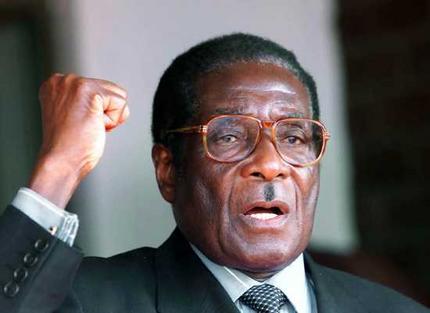
*Robert Mugabe's approval rating of 24% is the lowest among the 19 presidents. His fellow Octogenarian, Abdulaye Wade did not fare much better either, with a 28% approval rating.
*Next time, I will look at this data more closely and look at other issues such as popular trust of presidents and perceptions of corruption by the presidency and officials in his/her office.
Tuesday, April 26, 2011
Re: Revisiting the issue of Maximum age limit for the presidency
Examining initially the gross changes which occur in the brain with ageing, it can be observed that the normal volume and weight of the adult brain begins to decrease from about 50 years of age. This is due to a reduction in the number of cells in a wide area of the brain: the cerebral cortex, the hippocampus, the substantia nigra, and the cerebellum....". - Martin Blanchard
Some years back, I presented a paper at the Constitutional Review Conference a comparative assessment on the Presidency in Malawi (the paper can be accessed at this link). One of the topics I touched on in that presentation was whether Malawi should consider introducing a maximum age limit for the office of President. Although there were many issues that I touched on (and a few that I would like want to take back), the topic of a maximum age limit elicited the most comments and discussion during the conference. I found it interesting that while many justified the retention of the minimum age limit of 35 on account that one's mental faculties are not fully developed to be President before this age, the proposal for a maximum age limit was resoundingly shot down (although in a later anonymous survey of key political leaders, there was overwhelming support for such a limit).
During the period 2004 and 2009, the president made a number of rather wacky decisions that we thought could be explained by the pressure of working in a political environment dominated by a very pesky opposition (which by the way, he rubbished on numerous occasions).
Despite getting a commanding legislative majority after the 2009 general elections, Mutharika's eccentric behaviour seems to get from bad to worse. Perhaps we should have seen the warning signs earlier when he embraced the establishment of the Mulhako wa Alhomwe to champion the course of one ethnic group instead of becoming a champion of the all-inclusive ethnicity of 'Malawi'. A few months back he not only ordered the re-introduction of the quota system for university selection, but he offered a rather bizarre justification for this policy by making unsubstantiated allegations about some corner of the Chancellor College campus!
In recent times, he has spearheaded the change of the national flag under the false illusion that Malawi has transited from the dawn of development to a full blown developed nation deserving of a full sun. Those of us who have been critical of the flag change have meanwhile been ridiculed as drunkards - talk of irony!
The President is also not content with silencing critics and trumping on the already weak opposition. Instead, he has gone further to embarrass its leadership by ordering a significant reduction in the salary of the Leader of Opposition. This was followed by the decision to bring his wife into cabinet (despite the initial protestations, the recent discolure that she's getting paid millions of tax-payers Kwachas for doing charity work just underscores the fact that her inclusion on the cabinet list was not an error in the first place).
In between, he has tried to incite mob action by not only calling for the deportation of the couple whose dog bit the family's long-serving guard, but he has also tried to frame the matter within the context of race (never mind that dogs are almost colour blind!). Malawi's traditional donors too have borne the blunt of the President's hallucinations. Oh, and by the way, his current deputy - handpicked by none other than the president himself - seems to be falling out of favour (and her predecessor too suffered a similar fate)
Given that there is now no opposition to worry about, why does our President continue to see ghosts where there are none? Why can't a man in his final term of office not seek to build a legacy of a unifier instead of the increasingly divisive character he has become?
Addendum:
Add to the list I compiled in August last year to even more bizarre decisions by the President in recent times:
- Building and opening a 'port' in Nsanje before carrying out a feasibility study and without liaising properly with Mozambique, where a significant proportion of the water way lies
- Ordering his supporters to 'deal' with his critics
- Decreeing K2m deposits for demonstrators
- Ordering the Inspector General of Police not to apologize to University of Malawi academics (could we speculate that he must have ordered the IG to summon Chinsinga in the first place?)
- Ordering University Lecturers to get back to work, even if he has no legal powers to do so
- Paying his wife millions of tax-payers Kwachas to his wife for doing charity work
- Ordering the deportation of the British High Commissioner, despite widespread condemnation and advice of many not to do so.
- We could add several issues to this list, such as the decision to withhold funding for his predecessors' medical bills; the recent scam at Malawi Housing Corporation where the president's brother got a house for a song; the decision to relocate the University of Science and technology from Lilongwe to the President's farm at Ndata...I am sure there are many other similar wacky decisions that I have forgotten
Sunday, April 17, 2011
Reflections from reading William Kamkwamba's Story
In a country where very few have access to electricity from an unreliable power grid, William's ingenuity offers an important lesson in that there are many Malawian geniuses of his calibre that are capable of coming up with local solutions to Malawi's myriad development challenges. Just imagining what is possible if all the William Kamkwambas of Malawi could be given support to unleash their creativity....no more unsafe drinking water; no more reliance on imported fertilizers; maybe some car designers that can build new cars locally and turn us into an exporting nation....some coming up with new medicines to cure us from disease and share with others outside Malawi the fruits of their discovery...the possibilities are infinite.
Sadly, the limited opportunities in our education system which prevents many William Kwamkwambas from emerging and nurturing their potential means that many inventors are out there that are not afforded the opportunities to invent. Yet, William's story teaches us more than the potential that Malawi has: it also tells us that despite countless obstacles, it is still possible to dream and translate those dreams into reality. Though belated, William, I salute you and am proud to count myself as your fellow Malawian.